
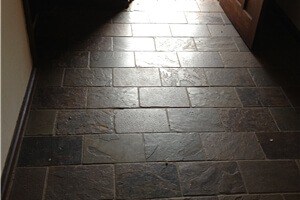
Slate floors are common in homes across Australia built between the 1970s and 1990s due to their toughness and durability. However, because these tiles are common in houses from this era, they can look quite dated, and many homeowners want to refresh their space with new flooring. Unfortunately, the durability of slate flooring, while fantastic for longevity, also makes it difficult to remove if you are not knowledgeable about the process.
Simply put, slate tile removal involves using a specially designed blade, combined with a jackhammer’s vibration, to get beneath the tiles and screed, separating them from the subfloor. Screed is made of sand and cement and is laid beneath slate to create a level bed for the slate to lie on.
The process of removing tiles on screed is very similar to a regular tile removal; however, the process is more intensive due to the durability of the bond between the screed and the slate tiling. These materials are also much thicker than normal ceramic tiles and glue.
As mentioned, slate tile floors are installed with the intention of longevity. Some slate floors may have been laid with thick concrete or rubber adhesive and, over time, have sections that are bonded more strongly than others. It is also common for slate to run across large sections of the home. This can make removal difficult as walls or similar features will need to stay unaffected. This inconsistent bonding and the nature of slate tiles in general mean the removal process is a lot more involved than a basic tile removal.
Given the difficult nature of slate flooring removal, there are also significant risks associated with this process.
Slate floors, when being removed, are prone to breaking up into small pieces. This creates huge amounts of silica dust, which can be harmful to people and pets.
Sometimes, slate flooring is not laid on screed and is instead stuck directly onto the subfloor. If this is the case, the removal process will be much more involved, and it is essential that you engage a professional tile removalist to ensure a safe and effective removal.
With slate flooring removal generating large amounts of silica dust, it is important to be mindful of the risks associated with inhaling silica dust. The main risk is contracting silicosis, which is a lung disease that causes shortness of breath, tiredness, chest pain and a long-lasting cough.
To reduce the risk of both harm to yourself and your property, it is recommended that you hire a professional to undertake the slate flooring removal process. A professional tile removalist will be able to scope out the site and understand the tools and processes required to safely carry out the removal.
At All Stripped, we use a specially designed blade with a dust extractor attached to it to effectively remove slate. This blade becomes especially helpful if the slate has not been laid with screed.
We also specialise in dust-free tile removal. Given the significant health risks associated with inhaling silica dust, we take this responsibility seriously. We remove all tiles, screed, glue and rubble using industrial vacuums, with dust sprouting attached to all our machines to control and minimise the spread of dust.
If you need a safe, effective and dust-free tile removal or a strip-out, contact us at All Stripped to organise a service.